
Endodontics
Root canal treatment using modern endodontic methods
Root canal treatment clears inflammation or infection inside a tooth and makes it possible to save even a badly damaged tooth. We work under the microscope using modern protocols — pain-free and usually in 1–2 visits.
01 / 04
Root canal treatment
What root canal treatment is
Inside every tooth is the pulp — soft tissue containing nerves and blood vessels. Deep decay, cracks or injury can cause it to become inflamed or infected, which leads to pain and can result in losing the tooth.
Endodontic treatment (from the Greek “endon”, inside, and “odous”, tooth) removes the source of inflammation and restores the tooth's function.
- saves your own tooth instead of extracting it
- removes the pain and the source of infection
- carried out under local anaesthesia
- performed under the microscope
Seeing a specialist early is the key to a successful, long-lasting result.
Timing: 1–2 visits

02 / 04
Root canal treatment
When endodontic treatment is needed
Pulp inflammation doesn't always cause sharp pain. See a dentist if you notice any of the signs below.
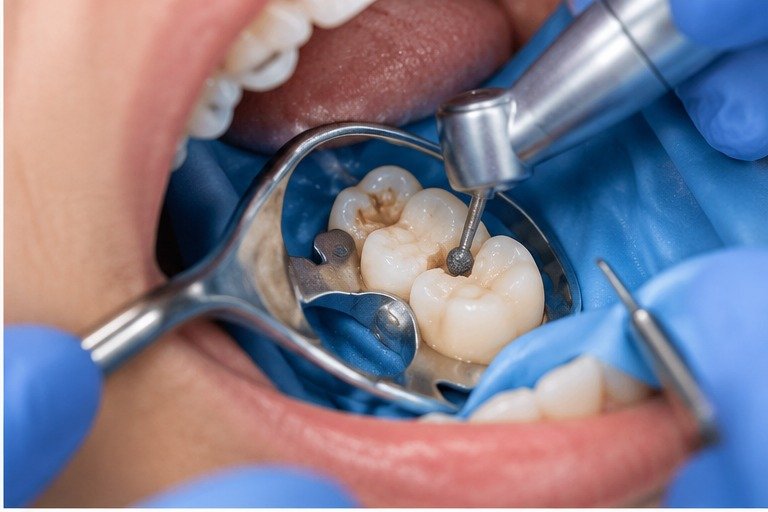
To assess the tooth and its canals, the dentist takes periapical X-rays and, if needed, a 3D CT scan. Diagnostics at UniDentArt →
- sensitivity to hot or cold lasting more than 10–15 seconds
- swelling, a fistula or a lump on the gum
- severe or nagging toothache
- a tooth injury
- deep decay or an old filling with inflammation underneath
The earlier treatment starts, the better the chance of saving the tooth.
Diagnostics: periapical X-ray or CT
03 / 04
Root canal treatment
How root canal treatment is carried out
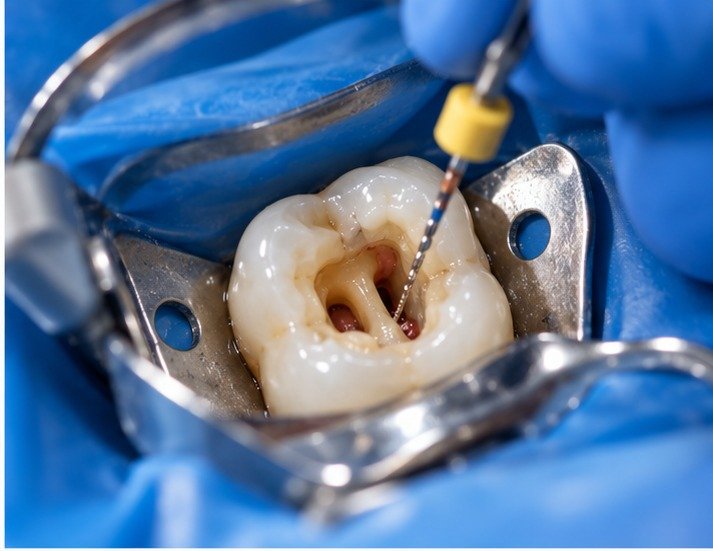
Modern root canal treatment is done in several stages. A rubber dam — a thin rubber sheet — protects the tooth from saliva and bacteria and creates a sterile working field.
The canals are cleaned with nickel-titanium instruments under the microscope, disinfected with ultrasonically activated antiseptics and sealed with gutta-percha and sealer. 3D obturation →
- diagnosis and local anaesthesia
- isolating the tooth with a rubber dam
- removing the pulp and shaping the canals
- disinfecting the canals — activated irrigation
- filling the canals with gutta-percha
- restoring the crown — a filling, inlay or crown
The number of visits depends on the canal anatomy and how inflamed the tooth is.
Timing: 1–2 visits
04 / 04
Root canal treatment
Why modern root canal methods matter
Modern endodontics combines high-tech equipment with precise protocols.
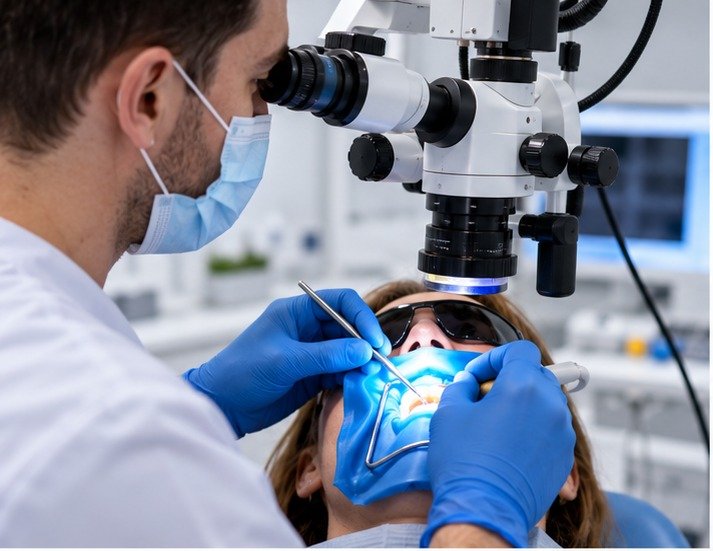
At UniDentArt, root canals are treated using a dental microscope, apex locators, rotary instruments, powered irrigation systems and biocompatible filling materials. This gives stable, predictable results. Where needed, we also use laser disinfection of the canals.
- greater precision and quality of treatment
- fewer visits
- the restored tooth lasts longer
- lower risk of the infection returning
If the root canals are treated properly, the tooth can last for many years.
Equipment: microscope, apex locator, powered irrigation
Treatment plan
A clear path from diagnosis to result
What the treatment involves and the order of the stages are decided after the examination. The dentist explains the options, timing and cost before any work begins.
Clinical assessment
Tests as clinically indicated
Stages and cost
An agreed sequence
Patient glossary
Terms
- Endodontics
- The branch of dentistry concerned with diagnosing, treating and preventing diseases of the inside of the tooth — the pulp and root canals.
- Pulpitis
- Inflammation of the soft tissue inside the tooth (the pulp), causing sharp or nagging pain. It often requires root canal treatment.
- Mechanical canal preparation
- The stage of treatment in which special instruments clean infected tissue out of the canals and shape them for filling.
- Irrigation
- Rinsing the root canals with antiseptic solutions to remove bacteria and tissue debris, often with ultrasonic activation.
- 3D root canal filling
- Sealing the root canals with warm gutta-percha and special sealers, fully isolating them from bacteria.
Frequently asked questions
FAQ
Is root canal treatment painful?
No. Modern anaesthesia makes the treatment completely painless.
Does a tooth have to come out after the nerve becomes inflamed?
In most cases, no. If the root canals are treated properly, the tooth can last for many years.
How long does root canal treatment take?
Usually 1–2 visits, depending on how complex the canal anatomy is and how severe the inflammation.
Why treat root canals under a microscope?
The microscope helps the dentist find every canal, check each stage of cleaning and deal with complex anatomy — reducing the risk of the infection coming back.
Can I find out the cost in advance?
Yes. After the examination the dentist draws up a treatment plan and tells you the cost of each stage before any work begins.
How do I book a consultation?
Call +373 22 50 80 80 or message us on WhatsApp. The clinic is open Mon–Fri 09:00–18:00, Sat 09:00–12:00.
You may also be interested in
Service
Anaesthesia in dentistry
Local anaesthesia, sedation, general anaesthesia
Restorative dentistryService
Bone augmentation
Bone grafting for implants, PRF
SurgeryService
Intraoral scanning
A digital 3D impression without impression paste
DiagnosticsSpeciality
Endodontics
All services in this speciality
View →