
Surgery
Bone augmentation: building up bone for implants
Bone augmentation is a surgical procedure that restores bone volume lost after tooth extraction, periodontitis, osteoporosis or jaw injury. It creates a solid foundation for implants and gives the face back its natural contours.
01 / 04
Bone augmentation
What bone augmentation is and who needs it
Adding bone, or bone augmentation, restores the volume of the jawbone. Bone loss affects both how your teeth work and how your face looks — it starts to appear older.
The procedure is recommended for patients who need a solid base for implants and want to restore the look and function of their teeth.
- you want implants but don't have enough bone
- you had teeth removed a long time ago
- you have had injuries or gum disease
- you want to restore the look and function of your teeth
The dentist decides whether augmentation is needed based on a CT scan.
Timing: surgery — 1 visit

02 / 04
Bone augmentation
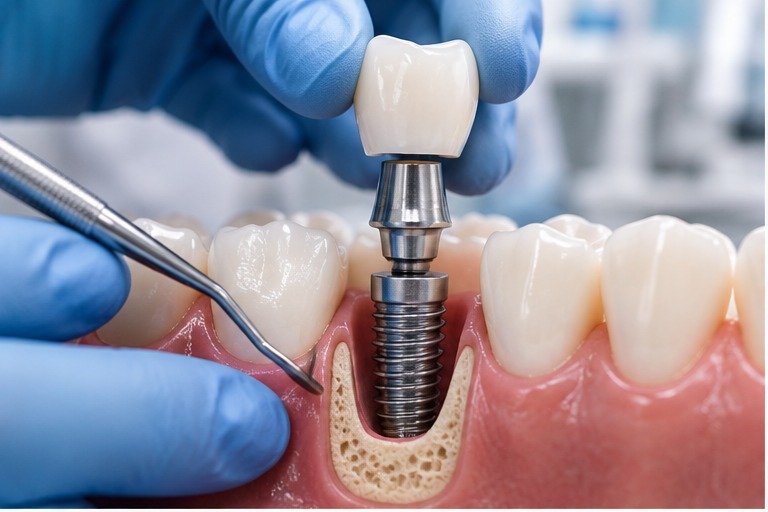
Why bone is lost and how this relates to implants
Without the load from a tooth, bone gradually resorbs. When the loss is significant, the gums recede and expose the roots, causing sensitivity and decay, and the smile — and your confidence — suffer.
Dental implants need solid bone support to last for many years. If the bone has resorbed, augmentation becomes essential for successful implant placement and for preserving the appearance of the face.
- tooth loss and no load on the bone
- gum disease that destroys bone
- injuries to the mouth
- age-related jawbone resorption
The sooner a lost tooth is replaced, the less bone is lost.
Diagnostics: panoramic X-ray and CT
03 / 04
Bone augmentation
The procedure step by step, and recovery
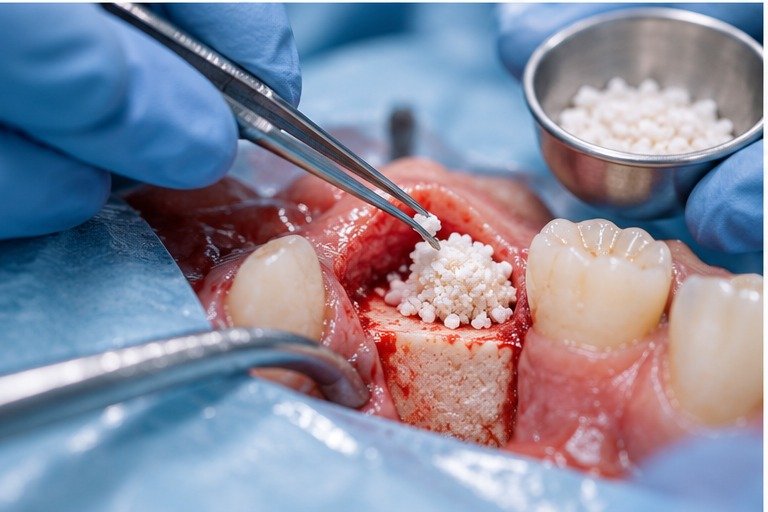
1. Consultation: examination, panoramic X-ray and CT, treatment plan. 2. Surgery: placing the bone graft material — natural or synthetic — together with implants if needed. 3. Healing: osseointegration takes up to 6 months.
After surgery you may have mild swelling or discomfort, as after a tooth extraction. In rare cases there may be infection or graft rejection (persistent pain and inflammation) — if so, contact your dentist straight away.
- follow the prescribed treatment
- eat soft, cool food
- rest and avoid physical exertion
- keep up careful oral hygiene
- stop smoking for better healing
Bone augmentation is highly successful with quality biomaterials, an experienced surgeon and careful aftercare.
Healing: up to 6 months
04 / 04
Bone augmentation
Materials and technology: bone grafts and PRF
The dentist chooses the type of graft material based on the size of the defect and the clinical goal.
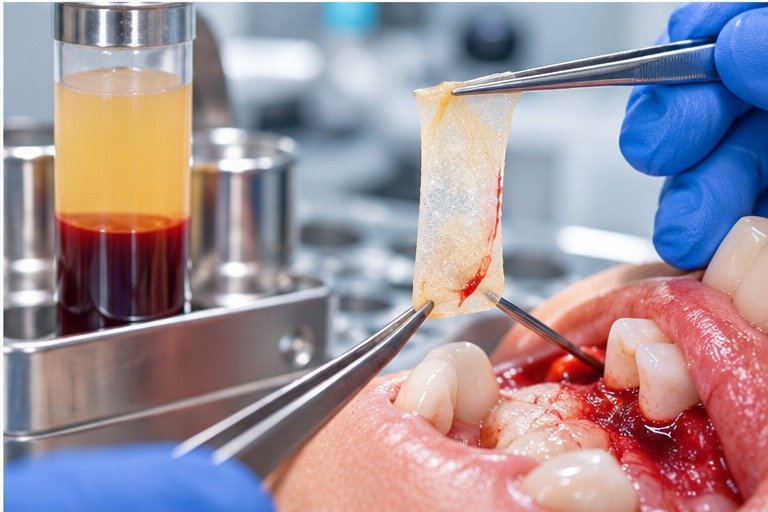
To speed up healing and tissue regeneration we use PRF — a fibrin concentrate made from the patient's own blood and applied locally. More about PRF →
- autograft — the patient's own bone
- allograft — bone from another person
- xenograft — bone of animal origin
- alloplastic material — a synthetic bone substitute
Augmentation is an important stage of implant treatment when bone has resorbed over time.
Technology: PRF — when indicated
Treatment plan
A clear path from diagnosis to result
What the treatment involves and the order of the stages are decided after the examination. The dentist explains the options, timing and cost before any work begins.
Clinical assessment
Tests as clinically indicated
Stages and cost
An agreed sequence
Patient glossary
Terms
- Bone augmentation
- A procedure to restore or build up jawbone when there isn't enough to place an implant.
- Bone graft material
- A special material (the patient's own bone or a substitute) used to increase bone volume.
- Implants
- Placing an artificial tooth root (implant) in the jaw. Sometimes bone augmentation is needed first.
- Bone deficiency
- A condition in which jawbone volume or density is not enough for an implant without additional treatment.
- Healing
- The period during which the graft material integrates and becomes part of your own bone. It usually takes several months.
Frequently asked questions
FAQ
When is bone augmentation needed?
When there isn't enough bone to place an implant securely — after long-ago extractions, periodontitis, injury or age-related bone loss. This shows up on a CT scan.
Can the implant be placed at the same time as the bone graft?
Yes, if the clinical situation allows, implants are placed during the same operation. The surgeon decides based on the CT scan.
How long does the bone graft take to heal?
Osseointegration takes up to 6 months. After that, the next stages of implant treatment can begin.
Is it painful after the operation?
The operation is done under anaesthesia. Afterwards you may have mild swelling and discomfort, as after a tooth extraction; the dentist will prescribe treatment and give you aftercare advice.
Can I find out the cost in advance?
Yes. After the examination the dentist draws up a treatment plan and tells you the cost of each stage before any work begins.
How do I book a consultation?
Call +373 22 50 80 80 or message us on WhatsApp. The clinic is open Mon–Fri 09:00–18:00, Sat 09:00–12:00.
You may also be interested in
Service
Anaesthesia in dentistry
Local anaesthesia, sedation, general anaesthesia
Restorative dentistryService
Root canal treatment
Under the microscope, in 1–2 visits
EndodonticsService
Intraoral scanning
A digital 3D impression without impression paste
DiagnosticsSpeciality
Surgery
All services in this speciality
View →